
There and Here: Trump's War
My conversation with retired Rear Admiral William Center on President Trump’s war with Iran

The United States, at the direction of President Donald Trump in concert with the armed forces of Israel, attacked the Islamic Republic of Iran on February 28, 2026. In recorded remarks released on social media Trump called the action, “major combat operations.” He has since used the word “war” interchangeably to describe the strikes and Iranian retaliation.
Trump said the objective was to “defend the American people by eliminating imminent threats from the Iranian regime, a vicious group of very hard, terrible people.” The Administration has had multiple explanations for the “why now.” Secretary of State Marco Rubio floated the “Israeli trigger” reason when he said on March 2, 2026 that, “We knew that there was going to be an Israeli action, we knew that that would precipitate an attack against American forces, and we knew that if we didn’t preemptively go after them before they launched those attacks, we would suffer higher casualties.” That casus belli was walked back by Trump who claimed, “The decision to go in was 100% mine.” On March 17, 2026, however, Trump’s National Counterterrorism Center director, Joseph Kent, resigned, claiming there was no imminent threat from Iran, rather Trump acted under “pressure from Israel and its powerful American lobby.”
As the war unfolded over the past two weeks much attention has been given to the U.S. objectives, strategy, endgame and pre-war preparation for Iranian actions, like threatening traffic in the Strait of Hormuz. American and Israeli forces have delivered staggering blows to Iranian targets but the stated goal of “unconditional surrender” – strictly in the eye of the beholder, Trump – remains elusive.
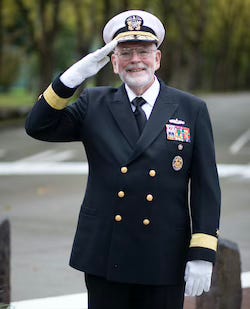
While strikes on Iran were in their early phase and Tehran’s retaliation was just beginning, I spoke with William Center, a retired rear admiral, who served over 35 years in the U.S. Navy. His extensive sea duty assignments included three deployments as a guided missile cruiser commanding officer in the Persian Gulf during the Iran-Iraq “tanker war.” Center was a specialist in arms control and nonproliferation and was Deputy Director for International Negotiations under JCS chairmen General Powell and General Shalikashvili, where he participated in U.S.-Iran negotiations on nuclear issues. Center worked with Iranian naval personnel in Iran and in the U.S. during the pre-revolutionary period when the U.S. Navy and the Iranian Navy had close working and treaty relationships.
In a separate conversation with Admiral Center, we discussed the nature of revolutionary Iran, its direct and indirect violence against Americans and U.S. interests since 1979. Iran should never be permitted to develop or acquire nuclear weapons and its ability to threaten its neighbors and export terrorism are dangers to the region and the globe. We also discussed that critical examinations of political decisions that affect U.S. national security are the responsibility of citizens and do not diminish the support for American military forces in the field.
Note: I served aboard USS Reeves, a guided missile cruiser, several years before Admiral Center commanded the ship. We are both members of the USS Reeves Association.

Interview with Rear Admiral William Center
March 1, 2026
Edited for length
[Patrick Ryan] Thank you, Admiral Center, for taking time today to talk about the strikes in Iran and the implications for our country.
Let’s start with President Trump’s announcement on “Truth Social,” yesterday morning, concerning the strikes. He said the objective was to eliminate, quote, imminent threats, unquote.
Yesterday on social media, you wrote that there was, quote, no super-secret magic intelligence, unquote, available to the president, which would make it clear it was imperative to launch this attack, at this time. What do you see as the factors that led to action against Iran now?
[RADM William Center] Well, today [Mar. 1, 2026], of course, we know something I didn’t know yesterday, which is that they were successful in what was clearly one of their objectives, possibly, the main objective, which was elimination of the Supreme Leader.
I find that troubling that they would do that, not that I support the Supreme Leader. I just don’t think that assassinating foreign leaders is a way to conduct international diplomacy. As bad as he was, the Supreme Leader, it’s not our call. It’s up to the people of Iran.
In any case, he was very careful to use those words “imminent threat.” Maybe I should say he was unusually careful in using those words “imminent threat.” The imminent threats were what would be the window dressing justification to give him the authority to do this under the War Powers Act.
Today, he said that Iran was two weeks away from developing a nuclear weapon. I will tell you that’s absolutely preposterous. There’s no way Iran could have fielded a nuclear weapon in two weeks. I don’t think the president has a clue about the process. I’m sure that no one in the Intelligence Community, who actually knows what they’re talking about, would inform the president that Iran was two weeks away from having a nuclear weapon.
They might have had accumulated a certain amount of nuclear material that could have ultimately, at some time, become a nuclear weapon. I wouldn’t disagree with that. But, nevertheless, there was nothing in this scenario other than the fact that they really wanted to catch this group of senior leaders in Iran at this meeting, so that they could take a shot at him.
And they were successful. I have to say that neither of those things is easy, neither getting the intelligence nor getting the shot. Third, even if you get the shot, whether you kill the guy or not, that’s still not easy.
So, credit to the military troops that pulled it off and the Intelligence Community that got the intelligence. But, you know, the Constitution doesn’t equivocate on this, the power of making war, declaring war, rests with Congress.
Some lawyer might try to argue that, well, this isn’t really a war. This is just a military, you know, what did, President Putin call the Ukraine invasion, a special military operation. This will probably be, I think, in the best case for the president, it would end up being a limited military operation.
However, I’ve heard him time and time again refer to it as a war. Yesterday, when he was talking about it, he was warning the American public, correctly – I didn’t like his choice of words. But correctly he said our soldiers, airmen, seamen are going to be at risk, and there’s a chance that we’ll lose some. He said, that happens in war, you know.
No question. He said war. And it is. And, you know, today we learn that we’ve already lost three people. I suspect we’ll lose more.
So, number one, I think he was prompted by that window of opportunity, to get Khamenei. Number two, I think he was unhappy with the speed the negotiations with Iran were advancing. You know, it’s not like a real estate negotiation.
I worked on the beginning stages of the policy roadmap which ultimately led to the JCPOA with Iran when I was in my position with JCS back in 1994. It was quite a while before the agreement came to fruition.
At the beginning it was built around a set of sanctions. And the sanctions worked. I would have been among those who would say sanctions don’t often work.
In this case, the sanctions in Iran worked, and they worked well. The Iranian people felt the pain. They made it known to their leadership that they wanted the sanctions off, and the leadership responded by coming to the table.
There are so many people who, in all honesty, don’t really know what they’re talking about. They criticize that agreement [JCPOA], the agreement we had with Iran. It provided for live cameras in their nuclear facilities that we could monitor 24 hours a day. It also provided for regular inspections by the International Atomic Energy Agency, the IAEA.
They had never refused an IAEA inspection, and the IAEA never found any problems while the JCPOA remained in effect. The IAEA is the organization that historically monitored these sorts of agreements.
From my vantage point and the vantage point of the people that worked on this negotiation, Iran agreed to literally everything that we asked for when we imposed the sanctions. They didn’t withhold one thing.
In Iran’s public statements regarding the recent indirect negotiations through Oman, they said very specifically that they were willing to forego the right to have a nuclear weapon.
The Iranians said they had no desire to have a nuclear weapon but that they just wanted a peaceful nuclear program. President Trump said at the State of the Union, and all the way up until last week, that all he wanted was to hear Iran say the “secret words,” that we will never have a nuclear weapon. Well, Iran did, they said it out loud. Iran’s foreign minister said it on U.S. cable-news, looking at a TV camera. Apparently, the goal line moved. The White House said, no, what we really want is elimination of their ballistic missile program.
That is really asking a lot. You know, the ballistic missile program does have an offensive capability. It could be viewed as primarily offensive. I’m sure they [Iran] view it as primarily defensive. So, the process, the progress of the negotiations, I imagine, was a thorn under Trump’s saddle to get this moving. But that’s not the way nuclear arms control proceeds.
I can’t remember a case in the historical literature, and I got my master’s degree in this area, where any nuclear arms control was reached, because one side took military action against the other, or even seriously threatened it. It’s just not an effective way to negotiate.
The third thing is that the president is very fond of changing the subject. There are a lot of things he does not want to talk about right now. He doesn’t want more people digging too deep into various things. He’d rather have them focused on the war. And he’s done a really good job of getting people talking about the war and thinking about the war.
[Ryan] In a statement today from Vote Vets, Major General Paul Eaton said, “The Constitution could not be clearer. When launching wars of choice, especially with American lives in the balance, the president goes to Congress, and Congress authorizes it. That did not happen, and these operations are blatantly unconstitutional.”
What is your read of the basis for what the president described as major combat operations?
[Center] Under the War Powers Resolution the president has 48 hours to notify Congress after using the military in hostilities overseas. The president is limited to 60 days, plus a 30-day withdrawal period, unless Congress authorizes it in some way.
This is something previous administrations have honored. I agree others haven’t always honored the exact letter and spirit of the law. But at minimum, they wouldn’t have launched an operation like this without at least briefing the Gang of Eight in Congress in advance.
I think the president justifies it in his own mind and had people around him justifying it on the basis that if they went to Congress before the strike, they wouldn’t get the Ayatollah. And that was probably true.
There is a sufficient loophole in the law, which is you launch the strike, and then you go to Congress and get approval. But I would really be shocked if the administration couches this as seeking approval. They might couch it as informing the Congress of what they’re doing
It makes me uneasy, and it makes a lot of members of Congress uneasy.
You know, you can take it to Venezuela. He could even take it to the attacks on the boats that they sunk out in the ocean. Those are not the kind of acts that should be conducted without congressional authorization. And if you can’t get congressional authorization, that’s a sign you shouldn’t be doing them.
[Ryan] A lot of the combat operations in the last couple of decades have been under the cover of Authorizations for Military Force, or AUMFs, stemming from response to 9/11, going after Al Qaeda in whatever form or place.
[Center] Well, yeah, but even George Bush went back and got approval from Congress for the Iraqi operation because he needed the money. You know, we couldn’t have conducted a war with Iraq without funding.
So, we’ll see how this unfolds. It’s just not a good precedent.
[Ryan] You have extensive experience in command, deployed to the Persian Gulf during the Iran-Iraq war, the so-called Tanker War in the ‘80s, and in senior international affairs positions in the Pentagon. What are your thoughts on the Iranian regime, its history with the United States, and its position in the region.
[Center] Well, you know, the regime has been in power there for more than 40 years. The revolution took place over 40 years ago. I visited Iran briefly before the revolution.
The United States was going to sell them some destroyers and minesweepers. I was the captain of a minesweeper at the time, and they asked me to take a quick visit over there to talk to the people that were going be involved in the minesweeper program on the Iranian side. I found them to be extremely professional, extremely smart, and very aggressive. I haven’t been there since the 1970s, so I can’t comment on the current professionalism of the military.
I do know that Iran has, the president is right and he’s not the first one to say it, that obviously, Iran is a big funder of terrorism. They were a big promoter of it. They’ve been a promoter of asymmetric warfare. And it’s particularly problematic in the Middle East.
A lot of folks in America have trouble understanding the Middle East is not an Islamic monolith. There are two main branches, the Shia and Sunni, and that’s a big dividing line between Iran and many of the other states there. You notice Iran didn’t have any problem lobbing missiles into their fellow Islamic republics following the attack. In fact, if you added up all the missiles they fired, I’m confident they fired more into the Islamic countries than they did into Israel. There’s no love lost.
It’s just wishful thinking to think that we’re going to be successful in replacing that regime with a regime we’d like better, or that we can deal with, or that will get along with its neighbors.
I would cite these points of discussion. Even when we had boots on the ground, and not just boots on the ground, but a lot of boots on the ground, in places like Afghanistan and Iraq, achieving regime change, proved difficult, if not impossible.
And trying to do it, without having boots on the ground, and without having contact, and ways to materially support the leadership of the opposition, it just doesn’t seem feasible in any respect. And anybody that talks about it would have to do a lot of explaining about how that result is going to come about.
It’s hard for me to imagine. I don’t think anybody knows how many people were killed during the latest uprisings in Iran. The lowest number I’ve heard is 6,000. And I’ve heard numbers that are five times that. So, 6,000 is a heck of a lot. And here’s the thing. They were not killed with WMD. They were killed with small arms. Somebody walked up and shot a fellow citizen in the face. And that is a big deterrent. Tear gas will only go so far in controlling a riot. Real live bullets, they do a pretty good job.
And I think they’ll probably impose curfews and measures like that. They probably already have. They’re probably doubling down on their efforts to squelch opposition. They probably, since the attack, rounded up anybody they thought was a potential opposition leader and put him in jail.
So, I think the chance that a regime change there will go in a favorable direction … there will be a regime change in the sense that they’ll have a new leader. But my understanding is that the Ayatollah had a pretty good succession plan in place.
I made reference to the fact they were aggressive. I think they’ll find ways to disrupt the flow of oil. They won’t maybe be able to stop it forever, but they’ll interfere with the flow of oil through the Straits of Hormuz by making the insurance rates too high.
I can tell you, when I in the Gulf commanding USS Reeves, a guided missile cruiser three times between 1987 and 1989, it was Iran who were laying the mines in the path of our convoys of U.S. reflagged tankers.
My ship was behind the Bridgeton, a very-large crude carrier. We were escorting her when she hit an Iranian mine. I remember the ship’s master said, “I think we might have hit something.” The ship was so huge, you know, the mine explosion just made like a “poof.” That big ship just soaked up all the energy out of the mine. It didn’t do a lot of damage, but it sure has an effect on marine insurance rates. That’s for sure.
At that time the Iranians were very cocky. They would just come right up to you and challenge you. They would do everything they could to provoke you. We exercised all the restraint we could.
Then the cruiser Vincennes shot down an Airbus that was flying out of Iran, and all of a sudden, the Iranians were very, very circumspect and cautious. That happened because, you know, that was an atrocity by any description. Iran just sat back and waited for the world to react to the United States. But the world’s attitude, was just kind of, oh, well, it was Iranian. They just kind of blew it off. Iran learned from what they were seeing.
I think they’re way back on the cocky side again. I expect them to be very aggressive. Of course, I’m sure their Navy, their naval vessels have suffered a lot of damage in this series of attacks that’s going to impact that. I’m sure their aircraft have suffered a lot in the attacks. They’re going to be mostly relying on missiles, cruise missiles, and ballistic missiles and drones.
We must keep in mind they are very good at asymmetric warfare. Leon Panetta, former CIA director, former Secretary of Defense, former White House Chief of Staff, a guy that knows some stuff, was talking on TV this morning. He said it’s been well understood that the Iranians have sleeper cells here in the United States and that this is the time that they will seek to use them.
The problem we have is we can guard anything we want to guard. We just can’t guard everything.
It doesn’t matter what they attack. It’ll be a success. Think about how much we changed our behavior when we found a guy on an airplane trying to light his shoe on fire. No successful attack, nothing successful happened. But it caused us to modify our behavior and had a huge impact on the country.
We don’t know where and when they’re going to attack. And that’s not even talking about the attacks that are going to happen in Israel and all throughout the Middle East. I think there’ll be fewer attacks and less spectacular attacks, probably, in the United States, on our territory. But because we’re the United States, they’ll get a lot of publicity and publicity is the point.
We’re getting ready to kick off a big political campaign season for the midterm elections. A lot of candidates are going to be in public and pressing the flesh. They’re going to be in highly vulnerable positions, and if I was a candidate, I’d be nervous about that.
[Ryan] What do you think about Israel being the only country to participate directly with the United States in this operation? How are the Iran strikes affecting relations with our allies in the Gulf and elsewhere?
[Center] Well, you know, we just had the security conference in Europe, the Munich Conference, and I don’t think things could get much worse than they were then. The impact of the Greenland episode is still present. I think the president interpreted it that way as, you know, “So what are they going to do, put a stick in my eye?”
He didn’t expect anybody to climb on board for the Iran strikes. A lot of people look at this situation and think that Bibi Netanyahu encouraged the president to do this, and I’m sure he did. But I don’t think the president did it, just because Netanyahu asked him to.
It’s a whole different situation when you have, like, we did in Desert Storm, a coalition of the willing, you know, over 40 nations from around the world, saying that we’re going to kick Iraq out of Kuwait under a United Nations Security Council Resolution. Here the only volunteer you can find is Israel.
One of the things I’ve been most worried about in the last year is the future of NATO. I’m happy to see that NATO seems determined to survive with or without us. Some people would argue, if we aren’t part of it, it’s not the same. They would be absolutely right.
It’s not visible to the general public, they don’t understand that we use NATO procedures when we work with our allies. And it’s not just NATO allies. I’m talking about Japan.
I’m talking about Korea. I’m talking about Australia. I’m talking about, all the allies that we depend on. When my ship arrived in the Gulf there was a French ship there, there was a British ship there, there was a German ship there, there was an Italian ship there. There was a Russian ship there, obviously not a NATO member.
If NATO falls apart, all of that collaboration is going to go away. So, if you want to be out there on your own, be careful what you wish for. It just won’t be a good situation.
[Ryan] The Iran strikes are the latest case study in President Trump’s approach to foreign policy, with the operation to snatch Venezuelan President Maduro being another recent example.
What is your assessment of Trump’s international affairs record? Do we have enough evidence to start to define a Trump doctrine?
[Center] I was teaching the graduate seminar on U.S. foreign policy for 15 years at the University of Washington. If I was in my classroom, speaking frankly, this is what I would tell my students. The Trump doctrine is, “I decide what needs to be done, and then I tell people to do it.”
It’s not coherent, from my vantage point, it’s not coherent. The disrespect for countries that are true and faithful allies is extremely distasteful. There is his treatment of Canada. There is his linkage of national security issues with economic issues in a way that undermines both. It is not helpful. Clearly, he seems to feel that the United States should be the king of the roost in the Western Hemisphere. That’s fine.
I don’t see any reason why we need to have Greenland. We can do anything we want in Greenland now. We control the airspace and we have virtually carte blanche for building any bases we want. We closed up more than 50 bases up there over the past 50 years. And if we wanted to reopen one or two or ten, it wouldn’t be a problem.
This whole thing with Maduro … it’s troubling. We have ways of, with intelligence and operations, of sorting through the good guys and bad guys. But they’re not foolproof. He’s pretty casual about who we kill, and when we kill them.
You know, he was really speaking the other day with great apparent empathy for the Iranians who were killed during the demonstrations. But he doesn’t seem to have much empathy for the Iranians that have been killed over the last two days. I haven’t still been able to figure it out.
It is interesting, though, you know, he lost his national security advisor. There was a law about that, too, you know, the National Security Act of 1947. It specifies how these things are supposed to be done. Now, we have Marco Rubio fulfilling both roles as Secretary of State and National Security Advisor on top of being a negotiator in a lot of these things.
And the guys that he’s got out there negotiating, Kushner and Witkoff, they don’t have a lot of history here. And history is important in diplomacy. I learned that early when I sat down with international interlocutors to try to negotiate something.
You remember when Yugoslavia was coming apart, and we had the war in Kosovo. We’d go, sit down with those guys, and say, okay, tell me what the problem is and they’d say something like, “Well, 600 years ago … they did this, and we’re still not over it.” There’s not a lot of appreciation for that. And the Middle East is like that, to a very large degree.
We need a department that puts negotiations in the proper priority. Remember the military strategist Clausewitz, that war is the continuation of diplomacy by other means. Right. That doesn’t mean that when you get tired of talking, you start fighting. If you look at how we got into the world wars and the Korean War, et cetera, et cetera, et cetera, Vietnam War, it’s been just a bunch of blundering. Very, very troubling.
When I talk about the Diplomatic Corps because it reflects the fact that President Trump doesn’t consider it to be a priority. Simple as that. Anything that has negotiations in it, he thinks he’s the great negotiator, and he can run it from the desk in the Oval Office. And I can tell you it doesn’t work like that.
[Ryan] We covered a lot of ground. Any last thoughts?
[Center] I refer back to General Powell, you know, asking how is this going to end?
Did we know how this was going to end when we started the attacks on Iran? We knew how we wanted it to end, but I think that the desired end is very unlikely – meaning that we’ll have a new regime in Tehran that’s friendly to the United States, and we can have all the oil we want, and we’ll get things sorted out.
I don’t think that’s going to happen.
The question is, then, how long will it last, and how do we bring it to a conclusion?
I got the impression from the president’s remarks that he seems to feel we can just stop whenever we want. Unfortunately, it doesn’t work like that. The enemy has a vote.
MORE
“Bill Center stands front and center when it comes to leadership,” Jon Marmor, University of Washington Magazine, Oct. 25, 2020
“’Major Combat Operations,’ launched against Iran by President Trump – Transcript,” Patrick Ryan, There and Here, Feb. 28, 2025
https://thereandhere.substack.com/p/major-combat-operations-launched
“Tanker War in the Gulf: Operation Earnest Will, Diplomacy and Seapower in Practice,” Dr. James WE Smith, King’s College London, 06 Feb 26
“U.S.-Iran Relations: From Allies to Enemies, GovFacts, June 22, 2025
“What was in the Iran nuclear deal and why did Trump withdraw the US from it?”, Meredith Deliso, ABCnews, June 21, 2025
https://abcnews.com/Politics/iran-nuclear-deal-trump-united-states/story?id=123020009
“Fact Sheet: The Iran Deal, Then and Now,” Center for Arms Control and Non Proliferation, Updated June 2025
https://armscontrolcenter.org/the-iran-deal-then-and-now/
“The Joint Comprehensive Plan of Action (JCPOA) at a Glance,” Kelsey Davenport, Arms Control Association, February 2025
https://www.armscontrol.org/factsheets/joint-comprehensive-plan-action-jcpoa-glance
“J.D. Vance Defines the ‘Trump Doctrine’,” Chad de Guzman, Time, Jun 25, 2025
“Trump’s Donroe Doctrine explained: from Venezuela to Greenland and what’s next,” John O’Sullivan and Michael D. Carroll, MSN
Photo: RADM William Center, University of Washington Magazine